Tuesday, 30 June 2015

First day


As for my first day in my whole life in Abu Dis, I left my town Jamma’in at 7:30 am, sleepy face and the energetic body. I waited for 40 minuets to  catch a bus to go to Ramallah, yes I did it, WOOWW.
We passed through 3 Israeli checkpoints, we spent more than one hour on these barriers!
I was afraid to be late to my meeting’s at Dar Assadaqa in Abu Dis, after I arrived Ramallah I took a piece of cake and a cup of tea to make sure that am awake.
The bus’s motor started to rotate at 9:30 am and we fastened our seat belts and get ready to move, during the road you sadly see the settlements and brown colors on the solders. After about an hour I arrived heartily to Dar Assadaqa, we spent 60 minuets with the children there, was a very nice time.

Worth to be mentioned the suffering during this trip, you lose the time and the patience but you never lose HOPE. For me as a Palestinian guy,  I always remember the human rights firstly when I see the suffer everyday when we go through a barrier which takes a lot of time just to cross a 10 meters distance. Long live Palestine.

Wednesday, 24 June 2015

Sharing Iftar in Ramadan

During this month of Ramadan, Life Makers, a student led organisation, is handing out Iftar to those that may need it within Ramallah and its local area. This includes providing food and water for the homeless and poor of Ramallah, but it also includes handing out Iftar meals in the nearby refugee camp. It is often thought of as a month of simply refraining from food and water (from dawn until dusk) but here in Ramallah, they are working hard to get closer to the many more reasons why Muslims fast a whole month, every year; Ramadan allows Muslims to empathise with the needy but it is also about getting closer to being a better, kinder, more patient, more giving person. 

A short walk down from the busy bus station and you will find yourself in Minara square. There there is a white make-shift tent which houses food, drinks and dates all ready to be handed out. Students from universities including Al Quds and Birzeit help pack and organise each iftar gathering. Over the course of the five Iftars enjoyed by Muslims so far, 650 meals have been provided by the volunteers of Life Makers. 

And Ramallah isn't the only place where this is happening. All over Palestine, Iftar is being handed out to those who need it. 

A donor L J said "We celebrate Christmas and now Ramadan. I'm Christian and I'm helping my young friends. Palestine is beautiful." 


During this often misunderstood month, you would be forgiven for thinking Muslims regard their own hunger as paramount. Here however, the efforts of bigger hearts and smaller stomachs is much closer to the truth. 

Wednesday, 3 June 2015

First Days

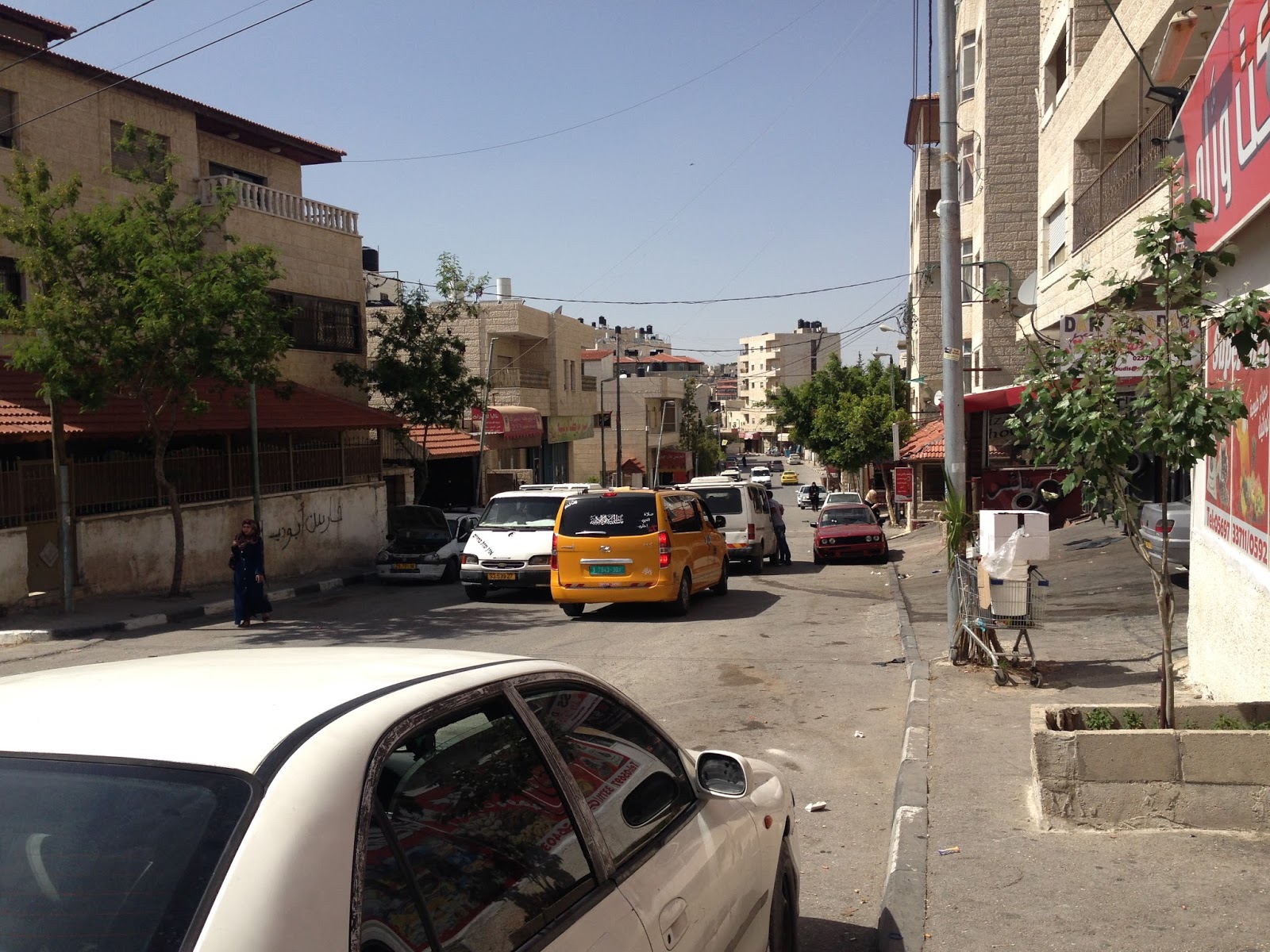
My first day in Abu Dis opened my eyes to so much already. I was introduced to the local coordinator who showed me Dar Assadaqa and took me to Falafel King, the local eating place. They served me the most amazing humus I ever had in my life and I can’t even describe the pain that hit me when I realised I would never taste anything like this back home. We headed on to Al Quds University which as only up the road. Entering the university from the streets of Abu Dis is like casually stepping onto another planet. Abu Dis is a very poor town whose situation has greatly deteriorated since the construction of the separation wall divided it from Jerusalem ten years ago. Many of the streets are in disrepair and littered, the walls are crumbling. By contrast, the university is modern, bright, clean and well maintained. It’s also extremely beautiful. The buildings are white and spacious and surrounded by trees and gardens, such as the Andalucía garden. There are also small cafes and drink stalls dotted around the grounds where the students sit and socialise and sip ice coffees or fruit cocktails. I am informed that the university is maintained with donations from the Gulf countries and wealthy Palestinian business men.  


Andalusia Gardens, Al Quds University 


Ramallah
In the student advice office I meet a whole group of interesting people. One young man is in charge of an animal rights project that’s being developed, the Palestinian Animal League. That initiatives like these are being built despite all of the problems that this country has been facing for generations is really heart-warming to me. It’s obvious that all the young people want is to build a country for the future generations. There’s a lot of support for the Communist party here in Abu Dis and I can’t help but wonder whether an alternative political system that failed so badly in Europe might actually be a promising contender in a place like Palestine. It’s an interesting possibility.

Birzeit
A couple of days later we visit Ramallah, the city acting as the current Palestinian capital. It’s very crowded and just like in Abu Dis, it’s more common to walk in the streets than on the pavements. The city centre is hectic but as soon as we move to the outskirts, the atmosphere calms down completely and it suddenly looks and feels like a southern European suburb. This place is also a world away from Abu Dis. The streets are filled with cafes and restaurants with pretty terraces and it’s obvious that the economy is much stronger and the mentality is vastly more secular. After wandering around the city for a while, we travel up to a suburb called Birzeit, home to one of the biggest Palestinian universities. I can’t get over how gorgeous this place is, in a way it’s easy to forget the problems. It feels like what this country could look like if there was no occupation. There’s real cooperation in this town, the locals work hard to maintain and develop it. Birzeit is also a mixed Muslim/Christian town and it’s beautiful to see how these two groups who shared this land for hundreds of years still live side by side like family. They haven’t let the wars and occupation divide them.


I leave Ramallah feeling positive. I really like this place, although I feel like there’s still much more to discover here.

Monday, 25 May 2015

Getting to Abu Dis: part 2

It turns out I picked quite an eventful first day to spend in Jerusalem. I genuinely liked the city and found it very beautiful, with the small exception of often being surrounded by people casually walking around with machine guns slung over their shoulder. This is not something you’re used to if you've grown up in London, or indeed most places I think. I had no idea what was going on at first, all I wanted to do was find a new sim card for my phone and exchange the British money I had left. Neither of these plans ended up working out for me so after hours of wandering aimlessly round Jerusalem, I decided it might be a good idea to head to the Jerusalem Hotel where I had planned to meet the other two volunteers Rowan and Hana.

Even that wasn't as simple as I had hoped. While walking through the city centre I noticed a huge amount of people were running around wrapped in Israeli flags singing and shouting. I am aware of the great love the Israelis have for their country, but it was fair to assume that this level of nationalism isn't a daily occurrence there. At first I naively concluded that some international sport event might be the cause of all this and carried on in my attempt to find a taxi. The attempt took about 3 hours as it turned out that most of the roads were closed because of the parade and by now it was way past the agreed 5 o'clock meeting time. The only taxi that eventually did stop for me was driven by an Arab, who kindly explained that the parade was nothing to do with sport but was infact a yearly occasion in which the Israeli settlers celebrate the taking of Jerusalem in the 6 day war by walking around the city waving flags and shouting. What a day to arrive!

I made it to the Jerusalem Hotel just in time as the girls had almost given up on waiting for me and weren't really sure what to do next. We introduced ourselves and headed off in the direction of the buses, hoping we hadn't missed the last one. I was struck by how different East Jerusalem felt to West as the girls showed me the way while recounting the eventful day they had had coming to meet me. It turned out they also hadn't been aware of the Israeli celebrations and had accidentally found themselves in the middle of a protest in East Jerusalem. The settlers had apparently been very aggressive and the soldiers, far from holding them back, were more interested in violently dispersing the protesters. As we walked past the scene of the earlier protest, we noticed one of the boys had a serious facial injury.

We did make the bus in the end and by this point, I was very excited to get to Abu Dis. The bus was full of Palestinian men going home from work and even though a couple looked slightly confused by our presence, no one made us feel out of place. The journey went pretty smoothly and the view of Jerusalem at night from the hill was stunning. It was tragic to think that many Palestinians also had this view every night. The view of a city that was once a major part of their lives, that they were now not even allowed to set foot in. It’s in moments like these that the reality of what these people have been through and are still going through, really hits you.
View of Abu Dis from our window


Getting off the bus, I finally realised I was actually in Palestine. I was struck by how much I felt at home already. The air was warm and still and there were sounds of dogs barking in the distance. I crawled into bed exhausted but happy and fell asleep in seconds. 

Sunday, 24 May 2015

Community Spirit

On Saturday and Sunday this week, the young men of Abu Dis came out in force; first to sweep, clear and clean the streets, then to paint all the curbs, and some walls, posts and pavements! I've never seen so many young volunteers working so willingly to improve the environment of their local community. They worked well into the night, and all through the town. This morning everything is bright and shiny!

Thursday, 21 May 2015

Getting to Abu Dis part 1


A couple of weeks ago, I made a decision that I think only people who feel they've been offered a unique opportunity make. I was offered a chance to travel to Palestine and volunteer with the local community. For those of us in the world that care passionately about the situation out there, being offered something like this is sort of equivalent to an astronomer being offered a trip to space.
The only catch was that I had to make my decision in a of matter hours, the other volunteers had already been out there for a month and I was only lucky enough to go because they had funding for one more person. I said yes, of course. This meant I needed to give notice at my job, move my things out of the flat I was staying in, book a flight and say all my goodbye’s in what felt like seconds. Those couple of weeks are now a bit of a blur. Leaving my life in London behind didn't feel like much of a sacrifice for what was essentially an opportunity I had waited years for and had never fully believed would ever come my way.

Sitting in Luton airport waiting for the flight to Tel-Aviv, I felt strangely calm. Almost like I was just heading off to another day at work. The flight was one of the smoothest in my life, but it did feel a lot longer than five hours. Still, I suppose that’s what Easyjet does to you.

Soon, it was time for the inevitable airport security experience. Having an Arabic surname like mine meant that the odds of simply walking through customs were pretty slim. Sure enough, the welcoming smile that lit up the customs officer’s face as I approached the desk with my British passport quickly disappeared as soon as she read my full name. The questions then followed... Relatively normal ones to begin with.” Is this your first time in Israel? What is the purpose of your visit? How long are you planning to stay?”  Then gradually less normal. “What is your father’s full name? What was his father’s full name? What nationality is he?”  It seemed strange that she would be so interested in my father’s family, given that they weren't actually the ones visiting the country, but nonetheless I answered everything politely. I was then told to go and sit in the waiting room while she kept my passport. There were several others in the waiting room, including one girl who was on her own and didn't look much older than 16. She was crying.


Not feeling reassured, I sat and waited for about 20 mins before another woman came to find me. I followed her into the office and was asked the exact same questions again. She wasn't particularly unpleasant but it felt quite frustrating to give the exact same information a second time, as if the first time was supposed to be some sort of rehearsal. She also wanted all of my contact details in the UK before telling me I could go. “Brilliant, that wasn't so bad” I thought, assuming that was the end of it. It wasn't. I then had to sit in the waiting room for another 45 mins before a third woman came to find me. All of the same questions followed once again but this lady was a little more aggressive. She wanted more specific information about my father, as well as all of my UK contact details again and ALL my email addresses. She was very clear about that. Then it was time for another hour in the waiting room, before finally being given back my passport and a small paper which turned out to be a visa (which they didn't bother to mention) and shown the way out. 

It suddenly hit me that I had no idea where my suitcase might be, since it had now been almost three hours since we’d landed. I was very happy to find it waiting for me by the baggage claims, grabbed it an bolted for the door thinking what a good call it was that I had planned ahead to spend the night in Jerusalem rather then head straight for Abu Dis. There would have been no buses at this time of night.

Tuesday, 28 April 2015

A photo of the dead sea which is close to Jericho


To go to the Dead Sea a fee needs to be paid to the Israeli authority of 55 shekels, there are many settlers in the Jordan valley and near the Dead Sea as it is an Israeli controlled area.