Monday, 17 August 2015

A Month in Abu Dis: Summer Camp Trip to the Fire Station

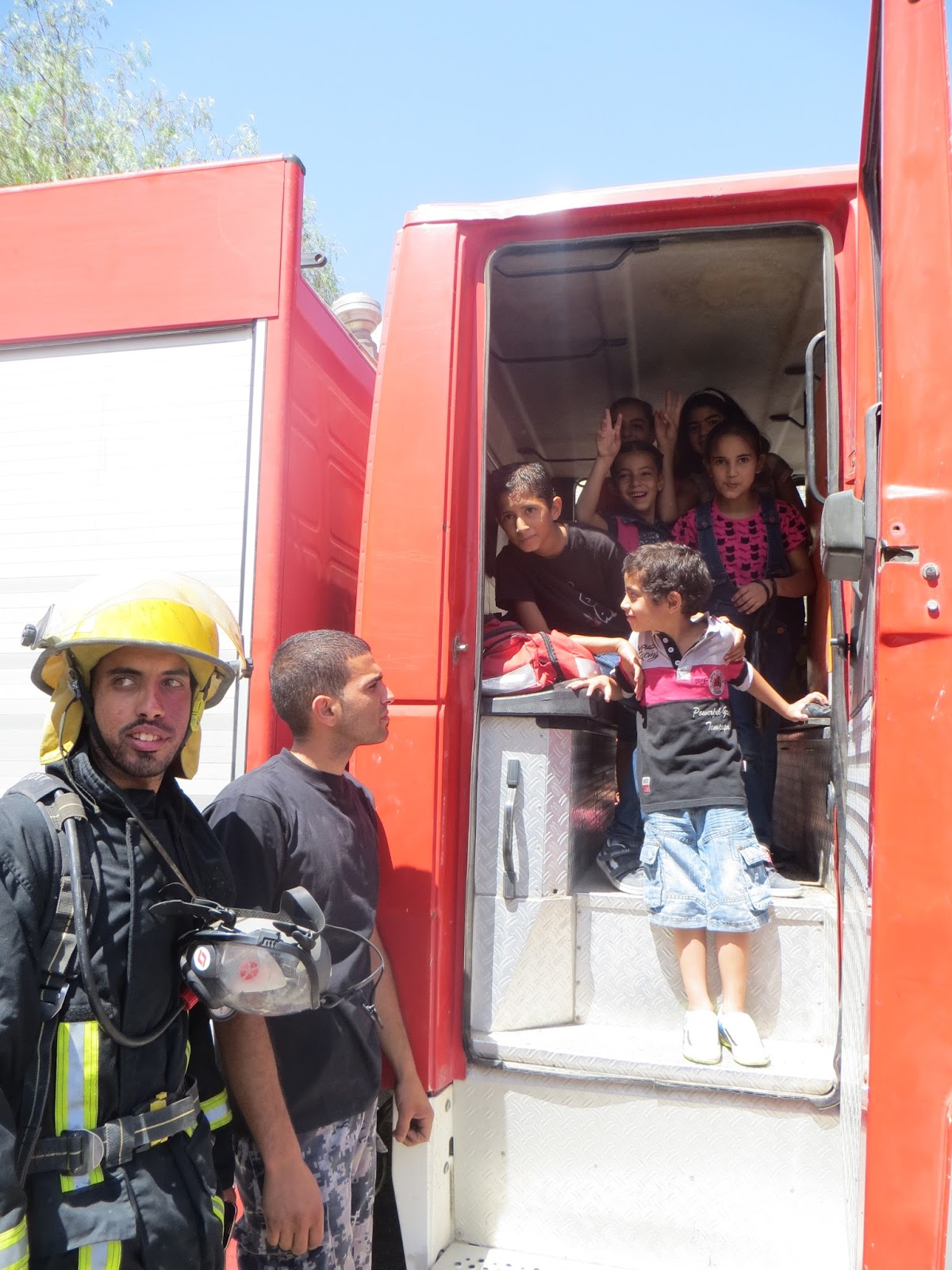
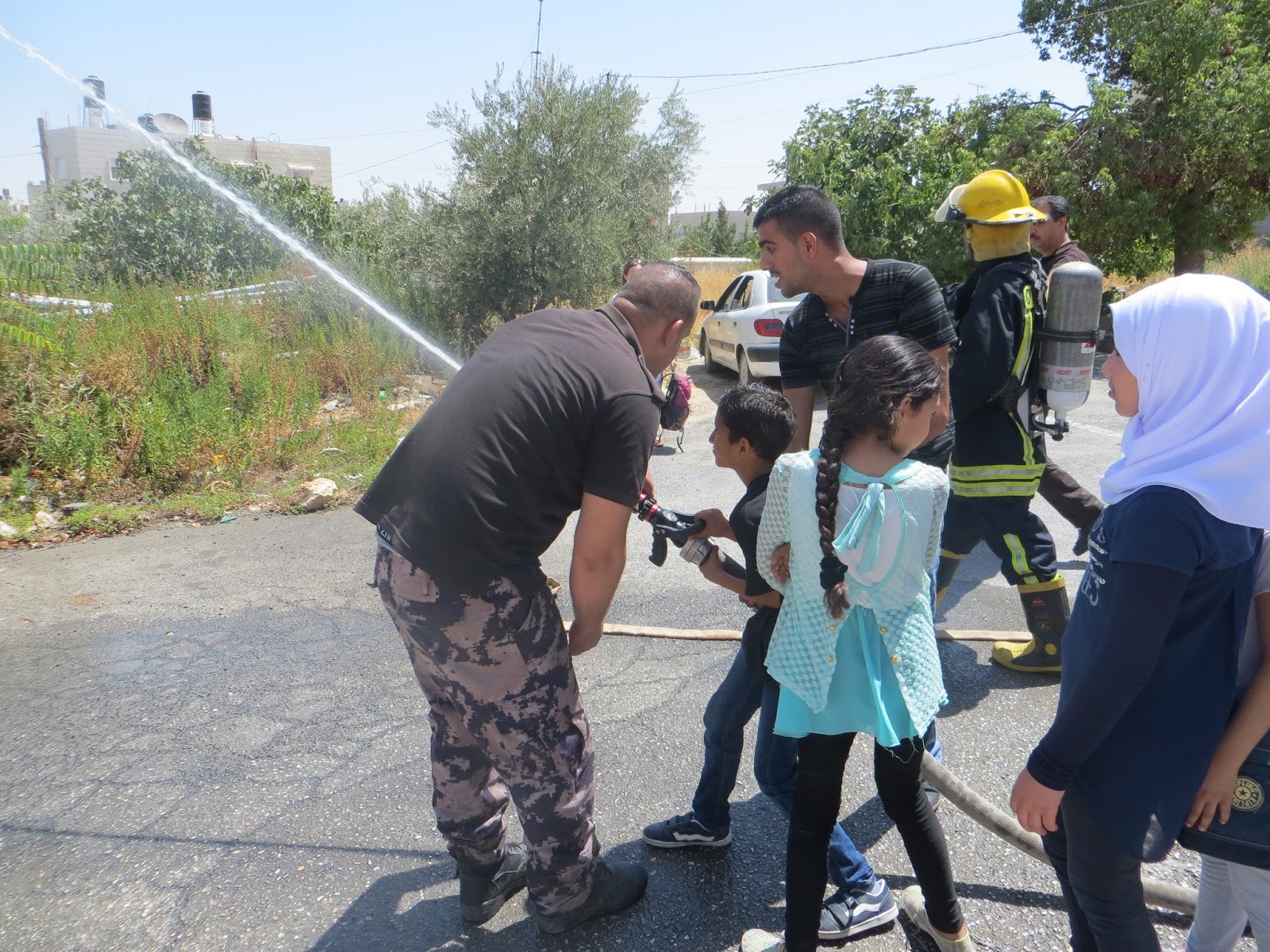
We took the children to visit the local firemen. They loved it! I don't think I've seen them that interested in anything else so far. They were shown all the nooks and cranies of the fire engine, had a go with the hose and one of the local volunteers got fully dressed up. When we made it back to Dar Assadaqa, we had a run through the visit and the children made a list of all the things the firemen use. Definitely a successful learning experience!


Full concentration
Such posers!
Explaining the equipment in the fire engine

One of CADFA's finest in full fireman gear
Exploring the fire engine
Learning some fire extinguishing skills


Saturday, 15 August 2015

A Month in Abu Dis: Summer Camp Trip to Bethlehem

Thursdays are day trip days at the summer camp. This time, the destination was Bethlehem.


The first stop was the Lajee Centre in Aida refugee camp. Aida refugee camp is just on the outskirts of Bethlehem, with its edges cut off by the separation wall. 5000 people, including 3000 children live there. The camp was set up in 1950 as a temporary home for the many Arabs who had to flee their villages during the war in 1948, hence the big key over the entrance of the camp, symbolizing their desire to return. The Lajee Centre (lajee means refugee in Arabic) was set up as a cultural and educational place for the youth of Aida camp. They do really fantastic work, you should check out their website (it will explain things better than I could):
And some articles on the Lajee Centre and Aida camp:
http://www.haaretz.com/news/diplomacy-defense/.premium-1.670464 (a roof gardening project in Aida)
https://electronicintifada.net/content/stuck-between-wall-and-occupation/8752

Aida Camp


Some of the graffiti on the wall 

The children were given a talk explaining what refugees are and life at Aida camp. We then walked around Aida and spent some time in the lovely garden and playground of the Lajee centre. 
 
The Lajee Centre Playground

Tear gas canisters we found in the playground

After visiting the camp, we went over to a park to play in the shade during the hottest hours of the day. The kids especially enjoyed the swing set!


The final stop was more cultural: the Church of the Nativity and Manger Square in Bethlehem (of which I have apparently failed to take a decent photo of - google will have to be your friend!).


Tuesday, 11 August 2015

A Month in Abu Dis: Start of the Summer Camp

The summer camp at Dar Assadaqa started the first Sunday of August. With the unprecedented heat, 40+ degrees (apparently up to 10 degrees above average), every morning we wait wondering how many kids will brave the sun on their walk over. So far, so good, we usually have 20 to 30 kids every day, aged 7 to 17.

Some of the children come from as far as East Jerusalem, via the checkpoints. Apparently there aren’t many affordable summer camps available and it can be difficult to keep kids, especially teenagers, off the streets and out of trouble. Just last Monday, a grenade went off in a street close to Dar Assadaqa and there was some debate about whether it was safe to let the kids leave in case the Israeli army arrived. Luckily, there was no escalation and everyone got home safely.

We have rediscovered (the Arab versions) of Chinese whispers, rock-paper-scissors, hangman, haraka stop (walk stop) and mime games. The language barrier is a bit of a struggle, especially with the younger ones. I’m learning some Arabic as I go along and we’re slowly teaching some English to the kids (or at least trying our best!), with a lot of help from the Palestinian volunteers. There also isn’t much available at the centre in terms of games to play, so we’re having to be a bit more creative, one of the results being an empty water bottle bowling set that has proved pretty popular! (If anyone has ideas, please do feel free to suggest)

On Tuesday, we took the kids around Al Quds University and the Prisoners Museum. At the university, they discovered lectures rooms, computer rooms and a mock tribunal in the law faculty. In the Prisoners museum, there were posters on display demanding the liberation of prisoners and photos of the detention centres. There was also a reconstructed prison cell. We finished the day off in the university gym with a big musical chairs game! 
Musical Chairs


The last two contestants!

In the Prisoners Museum

Saturday, 8 August 2015

A Month in Abu Dis: Magical Herbs

Stomach bugs are pretty common for travellers here and I am clearly no exception to the rule. I have however discovered a somewhat magical herb (possibly all placebo effect), picked out in a friend’s garden, that has pretty much cured my stomach ache overnight. It’s sage or meramiyeh in Arabic. Aniseed is also meant to be pretty good.
My medical kit


Boil some water, put a couple branches in (or aniseed powder/seeds), add some sugar or tea at your preference, et voilà! It’s not the best tasting drink in the world but then, nothing tastes good with an upset stomach.

M.

Wednesday, 5 August 2015

A Month in Abu Dis: Thoughts on the Duma Arson Attack

Friday morning news of an arson attack on the home of Palestinian family, taking the life of an 18 months old child, reached us. The suspected killers are Israelis from a nearby settlement. This form of violence even has its own name, “price tag attacks". Another two Palestinians have died in clashes with the Israeli army and the tension has increased throughout the West Bank and Jerusalem. This follows a long list of attacks and casualties from settlers and the Israeli army throughout the West Bank and also recently, stabbings by an ultra-orthodox Jew at the Jerusalem Gay Pride.

Here in Abu Dis, there were no big violent clashes with the Israeli military on Friday (at least nothing worse than the usual happenings). The people, however, are angry and frustrated. Netanyahu’s condemnation is met with a cynical laugh. The people I talked to believe that nothing will happen to the attackers, that the so-called Jewish extremists will be declared crazy, maybe even avoid prison. There will be no justice for this child and his family, no justice for the Palestinians. A volunteer’s father tells me: “This is our life. Every day. This is occupation.” There is no hope in his voice, just sadness.

As we walk along the street, a man stops his car and asks the local volunteers if they have told us about the attack, if we know what life is like here. That is the message the Palestinians here leave me with. They just want us to understand the reality of their daily life. They want to make sure the world knows, and put a halt to what is felt as a very efficient Israeli propaganda machine in global media. To be honest, I understand their feelings. Going through my BBC app newsfeed, it seems like Cecil the lion is getting more attention than the deadly violence in the West Bank.  

One of the volunteers here showed us the reactions of different politicians, Palestinian, Israeli, and around the world, images of the erupting clashes around the West Bank and explained his frustrations. Abu Dis is in Area B, so there is no police here, only the Israeli army. Even in Ramallah, in Area A, under the control of the Palestinian Authority and police, a simple phone call from Israel and the police desert the streets and leave way to the Israeli army. The settlements on the other hand, considered illegal under international law, benefit from state support and have beautiful tree lined streets and mansions. Settlements have security checkpoints at their entrance. Where is safe for the Palestinians?

Israelis and Palestinians in the West Bank are also not subjected to the same criminal laws, often resulting in more lenient convictions for Israelis and access to simple privileges like visitors in prison, which are extremely difficult/impossible for Palestinians to obtain. There is a generalized feeling here that reactions would be very different had the family been Israeli.


If you would like to read more about this, here are a few links (thanks Sybil for some of these!):
https://electronicintifada.net/blogs/ali-abunimah/how-israel-protects-its-settlers-who-burn-palestinian-children-alive

AAZA in Duma village

One of the CADFA volunteers in Abu Dis went with Abu Dis people to 'aaza' in Duma village to express condolences to the extended family of Ali Dawabsha aged 18  months who was burned to death and his parents and brother very seriously hurt in a settler arson attack that burned their house down. 

On the way, they had to take a very long route and come to the village from the opposite side as an Israeli army checkpoint at the beginning of the village was blocking the way in. They were told that the checkpoint was surrounded by settlers who were trying to provoke people coming to express condolences.

When they got there, they found that lots of people were coming to bring their condolences to the family - the top pictures show some of this.

Below are some terrible pictures from the house after the fire. And below that some Hebrew graffiti written by the settlers after the event (we don't know what it says, can you tell us?)

Our volunteer Umar wrote:

I have been privileged enough to go to the house where an Angel called Ali Saad Dawabsha lived. He spent 18 months of his life in that house, when one night while he was peacefully asleep some Israeli settlers set his house alight and as a consequence of this hideous act he was burnt alive. I'm sure you can understand a mothers heartache when her baby is crying for milk. Just imagine hearing your child's screams while he is burning to a slow death! You cannot even begin to imagine the level of desperation and helplessness his parents must have felt at that time. No one deserves to go through this! This is the harsh reality that Palestinians face on a daily basis. Please make people aware so another Palestinian child does not go through the same fate as Ali.


Tuesday, 4 August 2015

A Month in Abu Dis: First Impressions

The welcome has quite simply been fantastic! Abu Dis is a town of about 10,000 people just east of Jerusalem in the West Bank. It’s so full of life. Once it cools down in the evening (we hit 44°C yesterday!), the streets fill with people and cars drive by, blasting out loud music. We have found nothing but hospitality among the local inhabitants. Being a volunteer with CADFA, you instantly gain an adoptive family that has made adapting to this different part of the world so much easier.

The people here have made this place beautiful to me. The local volunteers have taken us under their wing and spend a lot of time showing us around and introducing us to this new culture. Everyone we have met so far is keen and open about sharing their stories and their country. We have learnt so much about Palestine and are making great friends in the process. At the end of the day, people are people regardless of where they are from, and we've found common ground and good discussion topics in politics, music, religion and football. The sense of humour here is simply brilliant, everyone is joking, smiling and laughing! It’s refreshing after the occasional depressing mood from London (no offence!).

As a European, there are some big differences you notice straightaway. Almost all the men here smoke, cigarettes or narghile, inside and outside, all of the time. Not quite our good old smoking ban. That was actually one of the first questions I was asked here, why British people can't smoke inside, it’s so alien here! The traffic/road is also mildly crazy. No one uses the pavement (because, you know, it’s not wide enough and discontinuous, or something along those lines), so you just walk in the middle of the road and try to avoid being hit by a car. The food is fantastic, plenty of fresh vegetables, rice, falafel and fruit. I have already had a cooking lesson to make warak dawale (stuffed vine leaves) that I will hopefully be able to put to good use as soon as I figure out how the hob works here! And of course, as a caffeine addict, I must mention the gloriously thick, spiced and strong Arabic coffee!

Still, even with all the jokes, smiles and cultural discoveries, it is impossible to miss the occupation here. From the minute you arrive, you learn the difference between a blue and a green ID that determines whether Palestinians are free to go to Jerusalem and Israel or if they need a special permit. You learn about the different Areas in Palestine. Here we are in Area B, under Palestinian Authority management but Israeli military control. There is no police, just the army to throw tear gas and fire “rubber” bullets at people. I have learnt that you should hold an onion to your nose or perfume if there’s tear gas around, a necessary life skill here. And more than anything, you cannot miss the separation wall. It’s 12m high, sometimes cutting off roads and making a trip to Jerusalem 30-60 minutes (sometimes longer depending on the checkpoint waiting time) instead of the 10 minutes it used to take! Everyone here has stories of how the wall and the occupation have changed their lives, from being forced to change schools or being unable to visit family on the other side of the wall, ambulances stuck at checkpoints and some patients not making it to the hospital in time.

Over the next few weeks, I will endeavour to recount my volunteering experience, but more importantly, the stories of the people here, the human rights situation and the day-to-day life in the West Bank. I hope that you will bear with me and enjoy discovering this country as much as I am. More to come.


The view from the volunteer guesthouse!

Abu Dis at nightfall
The separation wall near Al Quds University in Abu Dis